
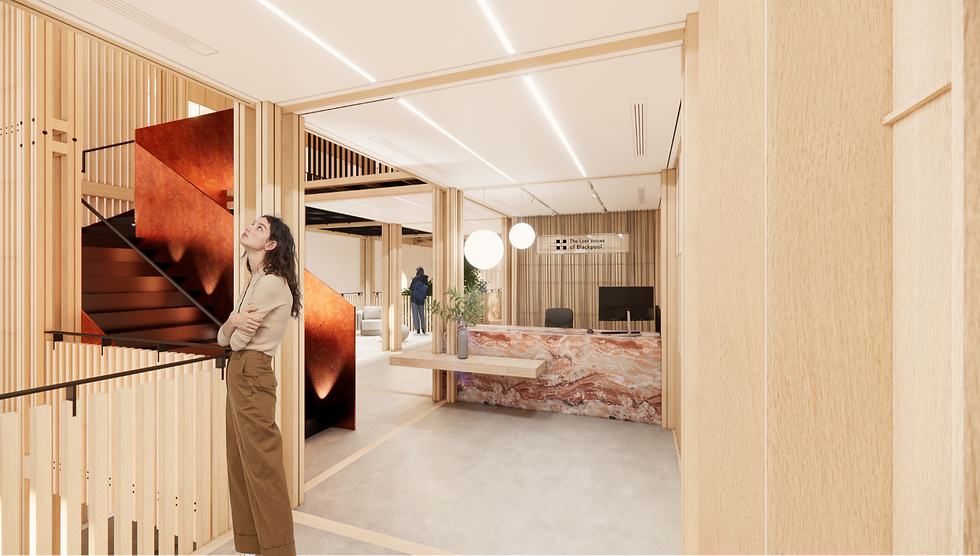
Reception Space
PROJECT
The Lost Voices of Blackpool
LOCATION
Blackpool, Cork, Ireland
YEAR
Final Academic Year 2026
CATEGORY
This project explores the adaptive reuse of Hewitt’s Distillery in Blackpool, Cork, transforming a disused industrial building into a contemporary cultural and community space. The proposal is centred on preserving local memory and reconnecting the building with its social and historical context, allowing the existing fabric to remain visible while introducing a new layer of intervention. The building is reimagined as an exhibition museum, The Lost Voices of Blackpool, which showcases the stories of those who lived and worked in the area through a digital and immersive exhibition.
The concept is informed by the language of scaffolding, translated into a series of modular, interlocking elements that form a new internal framework. These structures support circulation, exhibition, and programme, while remaining distinct from the original building. The scheme incorporates podcast studios for community use, enabling ongoing recording of local histories and ensuring the exhibition continues to evolve over time. Alongside this, the building includes a performance space for storytelling and small events, flexible rentable spaces for workshops and community activities, and a café and bar. Through material contrast and spatial sequencing, the design creates a layered experience that reflects the history, identity, and evolving life of both the building and its community.
Adaptive Reuse | Cultural Space

Site Map

Hewitts Distillery Watercourse Road

Historical Context
Hewitt’s Distillery has long been a defining part of Blackpool’s industrial and social history. Established in the late 18th century, it contributed significantly to the growth of the area before declining with changes in industry and production. Its closure marked not only the loss of a working distillery, but a shift in the identity and activity of the surrounding community.

The Concept
The concept draws on the language of scaffolding as both a structural and social metaphor. Traditionally used to support buildings externally, scaffolding is reinterpreted within the interior as a framework that supports community life. Following the decline of industry and the closure of the distillery, the surrounding community became fragmented. This intervention brings the idea of support back into the building, creating a new internal structure that reconnects people, space, and shared experience.

The Concept Model
The concept model explores the idea of scaffolding as a modular and adaptable framework, constructed using Japanese joinery techniques to allow elements to interlock without reliance on fixings. Set within a concrete base, the structure supports a fractured whiskey bottle, symbolising the disruption of the local community following the distillery’s closure. The scattered shards represent the fragmented community, held together by the surrounding framework. The modular scaffolding reflects the evolving history of the building, from whiskey production to industrial uses, suggesting its capacity to continue adapting over time in response to changing social and cultural needs.


The Exhibition

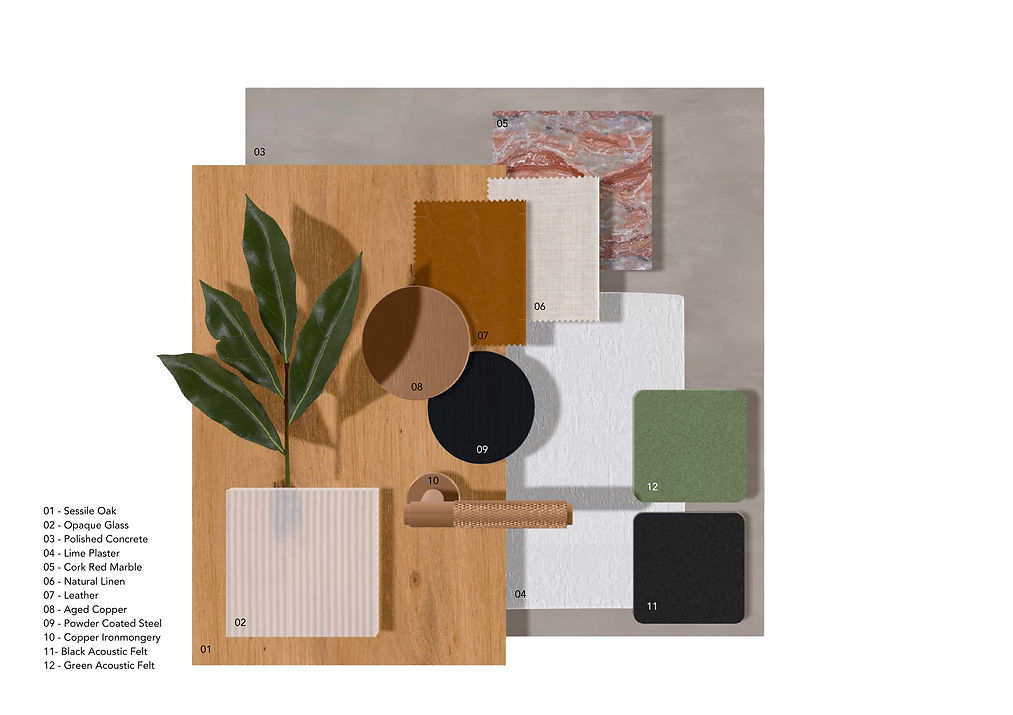

Materiality
Modular Module Exploded Isometric
Exhibition Visual
Double Height Exhibition Space
Double Height Exhibition Space

Performance Space Visual
Spatial & Technical Development


Design Presentations

Concept Design Presentation Drop

Design Development Presentation Drop